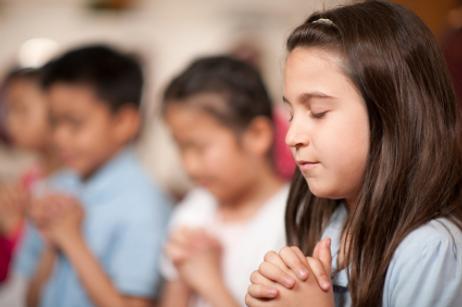
Prayer appears to be on its way back to public schools after a hiatus due to a 2000 decision by the U.S. Supreme Court prohibiting student-led prayers over public address systems at school events. Thanks to a new law in Mississippi, schools will need to adopt a policy that allows for student-led prayer in a variety of venues. While the law has been applauded by many, it has also received plenty of opposition, as well as hints at a future lawsuit.
Governor Puts Signature on School Prayer Law
The reports that Mississippi Governor Phil Bryant has signed a new law that allows students in Mississippi schools to pray at school events, over school intercoms, and before school athletic contests. All prayers issued by students must be accompanied by a disclaimer, stating the prayer is not endorsed by the school district. Governor Bryant explains that the purpose of the new law is to protect religious freedom in public schools in his state – not to establish or sanction religion in schools.
The Republican Governor was joined by supporters, including lawmakers and ministers, when he signed the bill into law. One of the ministers in attendance, Rev. David E. Tipton, Jr., was quoted in the as saying, “We have listened to the argument of the separation of church and state too long, and those barriers, I believe, is a façade with a certain agenda that has actually, I think, brought our nation to the peril that it is in.�
This video offers a look at the landmark cases that have helped defined the role religion can play in public schools.
Tipton added that he believes there are barriers to expressing religious faith in schools, saying, “Yes, there are barriers there that a person or child is afraid to speak anything related to God or Jesus because of lawsuits or things like that. So I think this legislation will be a positive thing for the state of Mississippi.�
The former governor of Arkansas, who is also a minister, agrees that prayer belongs in schools.
“We ask why there is violence in our schools, but we have systematically removed God from our schools,� Huckabee was quoted in the New York Times as saying shortly after the Newtown school shooting left 20 students and six adults dead at the school. “Should we be surprised that schools become places of carnage?�
The law is not the first of its kind in the United States. Last year, Missouri voters approved an amendment to the state constitution that allows residents of the state to acknowledge and pray to God in public schools. South Carolina has also introduced legislation that would allow for a moment of silence at the beginning of the school day that would allow students to pray if they choose. Virginia has a similar amendment to Mississippi’s working through the legislative process at this time.
Opposition to the New Law
Not everyone in Mississippi is in favor of the new law. Some have voiced concern that although a disclaimer would accompany the prayers, it could make some students uncomfortable at school events. Others have asked whether the simple act of saying a prayer could be construed as proselytizing in public schools – an act prohibited under federal law. There is also worry that those vying for prayer in school may not want to include all faiths in their support.
Sid Salter asks in an op-ed piece in the , “Does the law allow school-sanctioned public student expressions of basically Protestant or evangelical prayers and religious beliefs, or does it broadly allow Christianity, Judaism, Islam, Buddhism, Hinduism, and other faiths to have equal expression? What about paganism? Atheism? Agnosticism?�
This video reports on whether prayer in public schools should be banned.
When the total picture of prayer in schools is surveyed in this matter, the questions become considerably stickier. Bear Atwood, legal director for the Mississippi ACLU, told the New York Times, “People never think, what if it’s a different religious prayer than my child’s faith?�
The Question of Constitutionality
Atwood also pointed out that the new law may be proven unconstitutional in the long run, particularly if it leads to proselytizing from a public school forum. Although Atwood was not present at the bill signing, she did tell that she believes the law “has serious constitutional issues.� She explained that while the ACLU will not be filing a lawsuit against local school districts right away, she believes that the next step is a likely one in the not so distant future.
“At the end of the day, do I think there will be a legal challenge?� she was quoted as asking at God Discussion. “Yes, which is unfortunate, because it is not the governor or the legislature that will get sued but the individual school districts and that’s not a very good way for them to spend their limited education dollars.�
This video from the PAstors Network reports on the question "Is school prayer and Bible reading Constitutional?"
However, Governor Ryan has stated in the media that his state is prepared to fight any potential lawsuit filed against the bill. He told the New York Times that he would “be honored� to spend taxpayer dollars to defend the religious freedoms of the residents of his state. He also stated that he believes the state is on firm legal ground in providing the opportunity for limited religious expression in public schools.
The law will go into effect in July of this year, which may be the time when the ACLU decides to take action. At that time, many eyes are sure to be on Mississippi as the state becomes a prototype in the pursuit of prayer in public schools that has become a major constitutional battleground in school districts across the country.
Questions? Contact us on Facebook. @publicschoolreview