The Role of Technology in Education
Technology has reshaped education over the past decade, moving from supplemental tools to central components of teaching and learning. In 2025, digital tools, platforms, and artificial intelligence (AI) are influencing how educational content is delivered, accessed, and assessed for students from kindergarten through higher education. This article explores current trends, evidence, policy considerations, and the implications for parents, students, educators, and policymakers.
The Evolution of Educational Technology
Education technology, or EdTech, refers to the digital systems used to support instruction, learning, assessment, and administration. Initially limited to basic computer labs and projectors, technology in education now includes cloud-based platforms, adaptive learning systems, virtual and augmented reality, and generative AI tools.
The global EdTech market continues to expand rapidly, underscored by sustained investment and adoption. In 2025, the global market was valued at approximately $233.8 billion, with projections suggesting continued growth into the next decade. This expansion reflects increasing demand for online learning, mobile apps, and AI-enabled solutions in schools and universities around the world.
How Students and Teachers Use Technology
Classroom and remote learning environments now rely on a diverse ecosystem of technologies. A large majority of educators use digital tools in daily instruction, while students engage with technology for collaboration, research, and assessment.
Recent data indicate that nearly all teachers incorporate some form of digital resource in their classrooms, with many employing interactive lessons and platforms that address different learning styles. Students report using EdTech to communicate with peers, access learning materials, and prepare for assessments, and a substantial share of learners believe technology equips them for future careers.
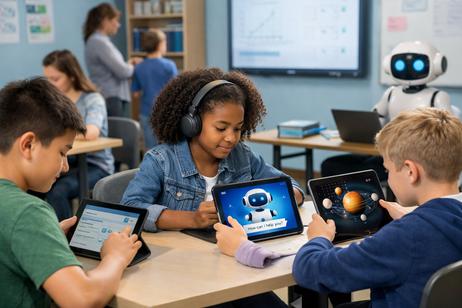
AI tools have become particularly prevalent. Surveys show that a majority of students now use AI for academic tasks such as brainstorming, writing support, and concept clarification, though many express uncertainty about responsible use without clear instruction and guidance.
Personalized and Adaptive Learning
One of the most significant advances in education technology is personalized learning. Adaptive learning systems use algorithms to tailor instruction to individual student needs in real time, adjusting difficulty levels and recommending targeted resources. Education researchers have documented cases where such approaches produce measurable learning gains, especially when coupled with strong implementation support.
These technologies can help close gaps by providing customized pathways, and in some government school systems, adaptive learning programs have been associated with improvements equivalent to nearly two additional academic years of learning over short periods.
Immersive and Experiential Technologies
Augmented reality (AR) and virtual reality (VR) are moving beyond novelty to provide immersive learning experiences. Schools and universities increasingly adopt these tools to simulate laboratories, historical environments, and complex concepts that are difficult to convey through textbooks alone. These immersive technologies have been shown to increase engagement and conceptual understanding, particularly in science, technology, engineering, and math (STEM) disciplines.
AI in Education: Opportunities and Challenges
Artificial intelligence is reshaping educational practice in 2025. AI-powered platforms support real-time feedback, automated grading, and student progress tracking. These tools hold promise for enhancing personalized learning and reducing administrative burdens on educators.
Investment trends reflect this emphasis. In 2025, global AI EdTech investment reached multibillion-dollar levels, with substantial venture capital flowing into startups focused on AI integration, and public funding in several countries supporting scalable solutions.
Despite these advances, AI integration poses complex challenges. Educators and policymakers are working to develop frameworks that promote ethical and responsible use, address academic integrity concerns, and ensure equitable access to AI-based tools. Training initiatives funded by a mix of public and private stakeholders aim to equip teachers with the skills needed for meaningful AI integration.
Policy Context and Equity Considerations
Government policy plays an essential role in shaping how technology is deployed in schools. In the U.S., long-standing initiatives aim to expand internet access and ensure that every student has the connectivity needed for digital learning. While connectivity has improved significantly, inequities persist, particularly in low-income and rural communities.
Advocacy groups emphasize the need for comprehensive digital learning plans developed in partnership with educators. These plans highlight support for professional development, equitable distribution of technology, and integration strategies that enhance, rather than replace, effective teaching practices.
The risk of widening existing inequities is real. Without sustained investment in infrastructure, training, and support, technology may reinforce disparities in access, opportunity, and outcomes. Policymakers must therefore balance innovation with equity, ensuring that the benefits of EdTech extend to all students.
Evidence on Outcomes
Research on the impact of technology on learning outcomes shows mixed results. Large-scale data suggest that in well-resourced systems, moderate use of classroom technology correlates with modest gains in standardized assessments. However, in systems with limited infrastructure or teacher support, technology use alone does not produce significant improvements and may divert resources from other priorities.
These findings underscore that technology is not a panacea. Its effectiveness depends on alignment with curriculum goals, teacher expertise, and robust implementation strategies.
Practical Implications for Educators and Parents
For educators, effective use of technology requires thoughtful integration into instructional design. Professional learning communities, ongoing training, and peer collaboration are key to maximizing the impact of digital tools. Standards such as the ISTE Standards provide frameworks for educators and administrators to gauge meaningful technology use in teaching, learning, and leadership.
Parents and caregivers can support students by fostering balanced technology use at home, monitoring digital activities, and engaging with teachers on how technology enhances learning. Parents should also be aware of school policies on data privacy and appropriate use of digital tools.
The Future of Learning with Technology
Looking ahead, the role of technology in education will continue to expand. Market forecasts project sustained growth in EdTech adoption, particularly in AI, mobile learning, and immersive experiences. The challenge for educators and policymakers will be to guide that growth in ways that promote equity, support teacher professionalism, and improve student outcomes.
Technology will continue to shape how education is delivered, but its success will hinge on intentional use that supports pedagogical goals, human interaction, and meaningful learning experiences. The future of education is digital, but human judgment, ethical practice, and equitable access must guide the journey.